
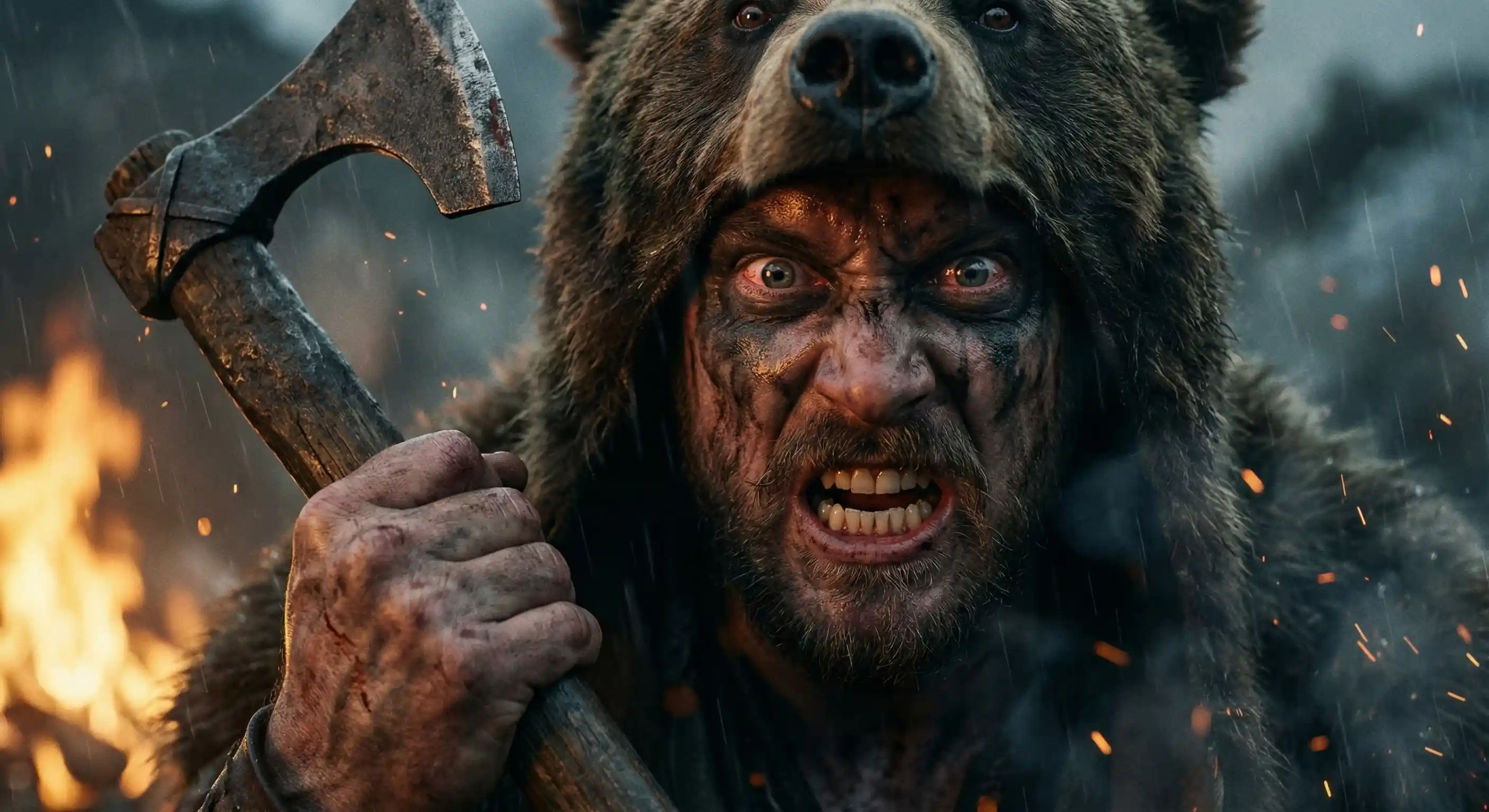
Few figures in Viking history have captured the imagination quite like the Berserkers. These fearsome Norse warriors, said to fight in a state of divine frenzy that made them immune to pain and fear, have become one of the most iconic images of the Viking Age. But how much of the Berserker legend is historical fact, and how much is myth? And what weapons did these extraordinary fighters actually use? Here is the complete truth behind the Viking Berserker legend.
Who Were the Viking Berserkers?
The word berserker comes from the Old Norse “berserkr,” a compound word whose exact meaning has been debated by scholars for centuries. The most widely accepted interpretation combines “ber” meaning bear and “serkr” meaning shirt or coat, giving us “bear shirt” or “bear coat.” This interpretation connects the Berserkers to the ancient Norse tradition of warrior shamanism, in which elite fighters ritually assumed the identity and power of powerful animals, most commonly the bear or the wolf.
Historical sources from the Viking Age and later medieval Icelandic sagas consistently describe Berserkers as elite warriors who entered a state of extreme battle frenzy before and during combat. This state, called “berserkergang” in Old Norse, was characterized by uncontrollable rage, extraordinary physical strength, apparent immunity to pain and wounds, and a terrifying appearance that demoralized enemies before combat even began.
The Historical Evidence for Berserkers
Contemporary Sources
The Berserkers are not purely mythological figures. They appear in some of the earliest written sources about the Vikings, including the 9th century Norwegian poem Haraldskvæði, which describes the warriors of King Harald Fairhair and specifically mentions his Berserker bodyguards. The poem describes them as wolf-coated warriors who carried bloody shields and fought with the ferocity of bears and wolves.
The Byzantine historian John Skylitzes, writing in the 11th century, describes Norse mercenary warriors in the Varangian Guard who fought with extraordinary ferocity and appeared to feel no pain during battle. While he does not use the term Berserker, his descriptions closely match the behavior attributed to these warriors in Norse sources.
Archaeological Evidence
Archaeological evidence for the Berserker tradition comes primarily from small figurines and decorative objects found across Scandinavia. The most famous are the Lewis Chessmen, a collection of 12th century chess pieces found in Scotland, which include several figures identified as Berserkers based on their posture of biting their shields, a gesture specifically associated with entering the battle frenzy state in Norse literary sources.
Several Viking Age helmet plates and sword decorations also depict warriors in what appear to be animal skin costumes, consistent with the bear and wolf warrior traditions associated with the Berserkers. These images suggest that the ritual assumption of animal identity was a real practice in Viking Age warrior culture, not simply a literary invention.
What Caused Berserker Frenzy?
The Ritual Explanation
The most widely accepted modern explanation for Berserker frenzy combines psychological, physiological, and ritual factors. Berserkers were almost certainly highly trained warriors who underwent specific ritual preparations before battle, including fasting, rhythmic drumming, chanting, self-hypnosis, and the deliberate cultivation of extreme emotional states through religious and shamanic practices associated with the cult of Odin.
The state they achieved through these preparations would today be recognized as a form of combat stress reaction, an extreme adrenaline response that temporarily suppresses pain perception, dramatically increases physical strength and aggression, and produces a narrowed tunnel-vision focus on combat. Elite soldiers in modern warfare have reported similar states during intense combat, confirming that the physiological basis of Berserker frenzy is real.
The Plant Theory
A popular but controversial theory suggests that Berserkers consumed psychoactive plants before battle to induce their frenzy state. The most commonly cited candidate is Amanita muscaria, the fly agaric mushroom, which contains psychoactive compounds that can induce states of agitation, increased strength perception, and altered consciousness.
While the fly agaric theory has captured popular imagination, most modern scholars are skeptical. The effects of Amanita muscaria are highly unpredictable and often include nausea and disorientation, making it an unlikely combat drug. The ritual and psychological explanation for Berserker frenzy is considered far more historically plausible by the majority of Viking Age researchers.
Berserker Weapons: The Axe Above All
Why Berserkers Chose the Axe
Norse sagas and historical sources consistently associate Berserkers with the Viking axe above all other weapons. This association is not accidental. The axe was the ideal weapon for a warrior fighting in the Berserker style, relying on overwhelming aggression, raw physical power, and the psychological impact of ferocious attack rather than the technical precision and defensive discipline required to fight effectively with a sword.
A hand-forged battle axe in the hands of a Berserker could be swung with devastating force in wide arcs that cleared space around the fighter, cutting down multiple opponents in a single sweep. Its weight and momentum worked with the warrior’s aggression rather than against it, amplifying the power of each blow. And unlike a sword, which requires careful edge alignment and controlled technique to be effective, an axe delivers destructive impact even with imprecise strikes.
The Two-Handed Axe
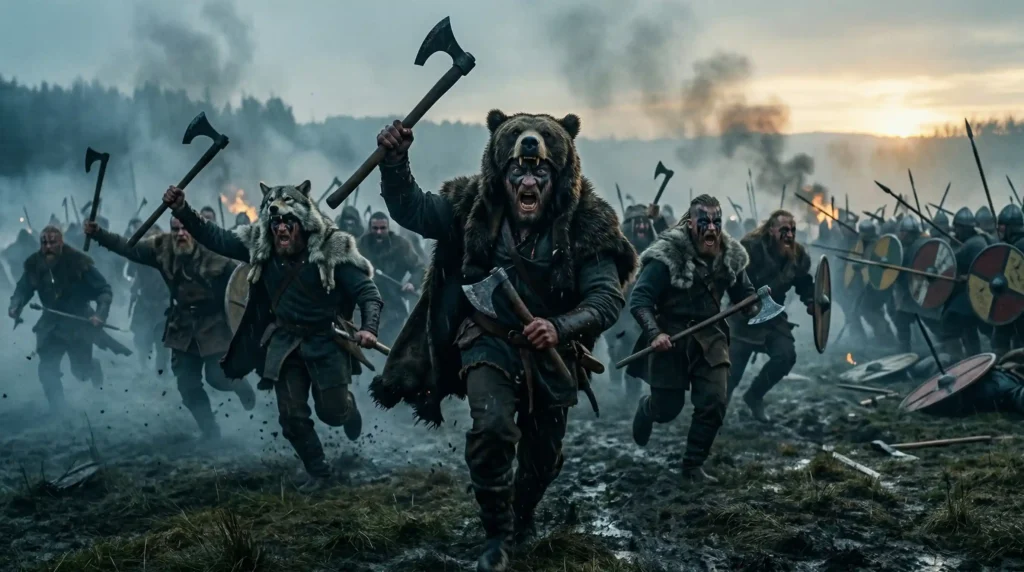
Many saga descriptions of Berserker warriors specifically mention two-handed axes, the Norse equivalent of the later Dane axe. These massive weapons, requiring both hands to wield effectively, sacrificed all defensive capability for pure offensive power. A warrior in the grip of battle frenzy, feeling no pain and apparently impervious to wounds, was uniquely suited to fighting with a two-handed axe, accepting hits that would stop an ordinary fighter in order to deliver his own devastating blows.
The psychological impact of a Berserker charging with a two-handed axe, howling and apparently immune to injury, was itself a weapon. Many historical accounts suggest that opposing forces broke and fled before Berserkers even reached them, overcome by the terror of facing fighters who seemed beyond human.
The Shield as an Offensive Tool
Despite their association with offensive weapons, Berserkers did carry shields, though they used them very differently from conventional warriors. Rather than maintaining a defensive shield posture, Berserkers are repeatedly described in sagas as biting their shields in a ritual act of rage intensification before charging. During combat, the shield became an offensive tool, used to bash and unbalance opponents rather than to block incoming strikes.
This aggressive shield use, combined with a two-handed battle axe or a large bearded axe wielded in the other hand, created a fighting style of pure overwhelming aggression that was almost impossible to counter with conventional defensive tactics.
Berserkers in Norse Mythology
The Berserker tradition is deeply rooted in Norse mythology and the cult of Odin, the chief Norse god and patron of warriors. Odin was himself described as capable of battle frenzy, and the ability to grant this gift to his chosen warriors was one of his most important divine attributes. Berserkers were seen as Odin’s special warriors, men who had been touched by the god and given a portion of his divine fury.
The association between Berserkers and the bear and wolf reflects the shapeshifting traditions of Norse shamanism. Odin himself was the greatest shapeshifter in Norse mythology, capable of taking any form at will. His warrior shamans, the Berserkers, emulated this power by ritually assuming the identity of the most powerful predators in the Norse world, becoming something more and less than human in the process.
The Decline of the Berserkers
The Berserker tradition declined significantly after the Christianization of Scandinavia in the 10th and 11th centuries. The new Christian culture was deeply hostile to the shamanic and pagan religious practices that underpinned the Berserker warrior cult, and Norse law codes from the Christian period explicitly criminalized Berserker behavior. The Norwegian Grágás law code, for example, prescribed outlawry as the punishment for a man who worked himself into a Berserker frenzy.
By the 12th century, the living tradition of the Berserker warrior had effectively ended, surviving only in the literary memory of the Icelandic sagas. But their legacy endured, shaping the popular image of the Viking warrior for centuries to come and giving the modern world one of its most powerful images of primal human ferocity.
Own the Spirit of the Berserker
The Viking axe that defined the Berserker warrior tradition remains the most powerful symbol of Norse warrior culture. At Viking-Axe.com, every axe in our collection is individually hand-forged using traditional Norse blacksmithing techniques, crafted from high-carbon steel and engraved with authentic Norse symbols. Browse our full collection of authentic hand-forged Viking axes for sale and connect with the warrior spirit of the Norse world.