
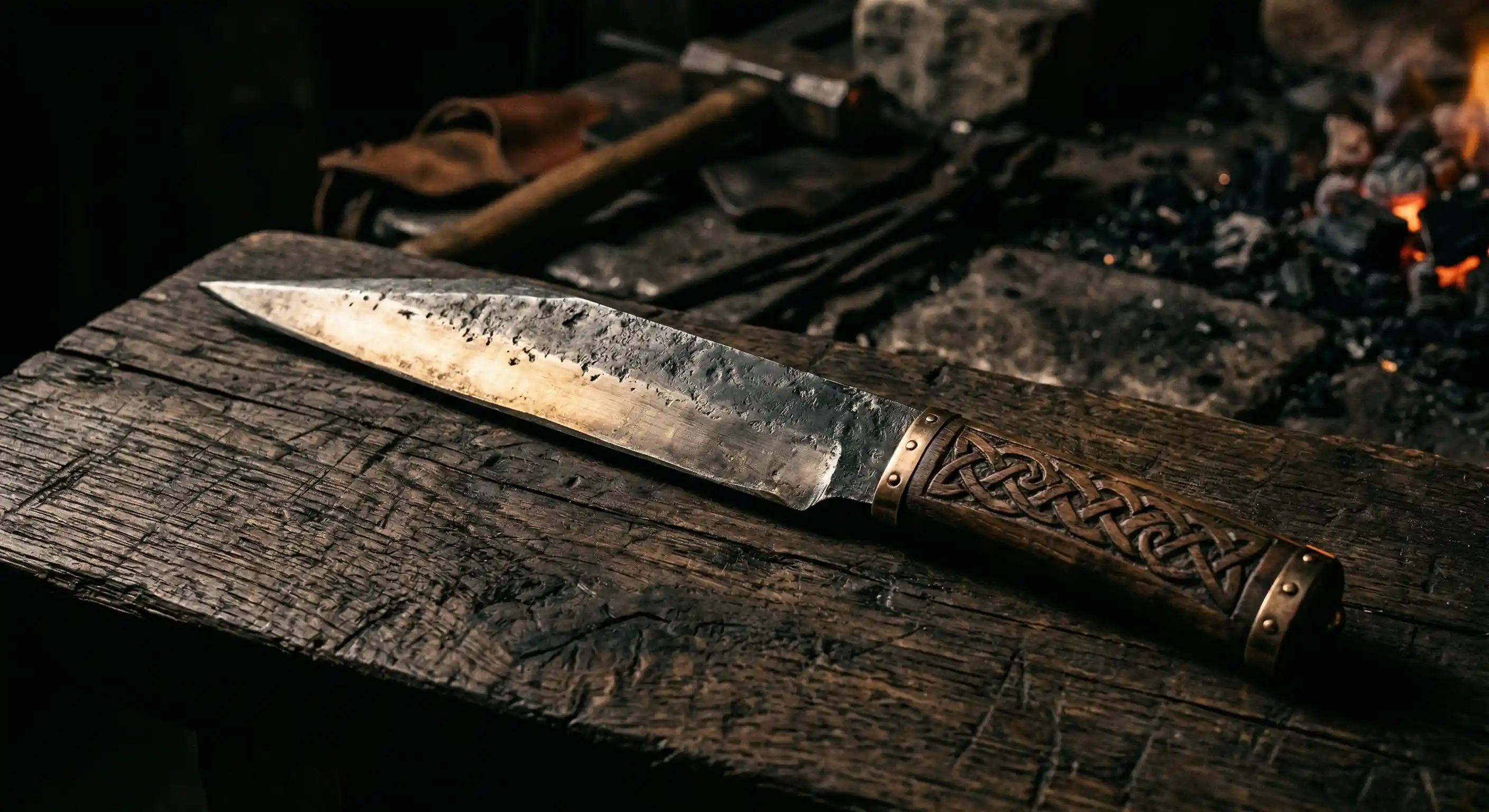
When most people think of Viking weapons, they picture the dramatic sweep of a battle axe or the gleam of a sword. But there was one weapon that every single Viking carried without exception, from the wealthiest jarl to the humblest farmer: the seax. This short, single-edged knife was the universal tool and weapon of the Norse world, as essential to daily Viking life as the longship or the shield. Here is the complete history of the Viking seax.
What is a Viking Seax?
The seax, also spelled sax or scramasax, was a single-edged knife or short sword used throughout the Germanic and Norse world from roughly the 5th to the 11th century. The name comes from the Old English and Old Norse word for knife, and it gives its name to the Saxon peoples of England and Germany, reflecting just how central this weapon was to early medieval Germanic culture.
Viking seaxes ranged enormously in size, from small utility knives with blades of 10 to 15 centimeters to large fighting weapons with blades approaching 60 centimeters, blurring the line between knife and short sword. What all seaxes shared was their single-edged blade, typically with a straight or slightly curved back and a cutting edge that angled upward toward the point.
The Origins of the Seax
The seax predates the Viking Age by several centuries, with early examples appearing in Germanic archaeological contexts from the Migration Period around 400 to 600 AD. By the time the Viking Age began in the late 8th century, the seax was already deeply embedded in Norse and Germanic culture as both a practical tool and a symbol of personal identity and social status.
Unlike the sword, which was a specialized weapon requiring significant resources to produce, or the Viking axe, which combined weapon and tool functions, the seax occupied a unique position as the one item no Norse man, woman, or child went without. Archaeological evidence from Viking Age graves confirms that seaxes were buried with people of all ages and social classes, making them the most universally distributed weapon of the entire medieval period.
Types of Viking Seax
The Utility Knife
The smallest seaxes were everyday utility knives, used for eating, crafting, hunting preparation, and dozens of other practical tasks. These Viking knives typically featured blades between 10 and 20 centimeters with simple wooden or antler handles. They were the Norse equivalent of the modern pocket knife, carried at all times and used constantly throughout the day.
Many surviving examples of small seaxes show evidence of heavy use and repeated resharpening, confirming their role as genuine working tools rather than weapons or status symbols. They were often carried in simple leather sheaths attached to a belt, accessible at all times.
The Short Seax
Medium-sized seaxes with blades between 20 and 35 centimeters occupied the middle ground between utility knife and combat weapon. These were the most common type carried by Viking warriors as a secondary weapon, used in close-quarters fighting when a battle axe or spear could not be effectively wielded.
Short seaxes often featured more elaborate handles and decorative elements than simple utility knives, reflecting their dual role as both tools and symbols of the warrior’s identity. Handles were typically made from wood, bone, antler, or horn, sometimes wrapped in leather for improved grip.
The Long Seax
The largest seaxes, sometimes called langsax or long seax, had blades approaching sword length and were clearly designed primarily as fighting weapons. These Norse knives were formidable combat tools, combining the single-edged cutting power of a large knife with the reach of a short sword.
Long seaxes are found primarily in high-status graves alongside swords and elaborate Viking axes, suggesting they were luxury weapons carried by wealthy and powerful warriors. Their size and quality required significant investment in materials and blacksmithing skill, placing them in the same prestige category as swords.
The Broken-Back Seax
One of the most distinctive seax designs is the broken-back seax, characterized by a blade with a straight cutting edge and an abruptly angled back that drops sharply toward the point. This geometry creates a blade optimized for thrusting as well as cutting, making the broken-back seax one of the most versatile fighting knife designs of the Viking Age.
Broken-back seaxes are particularly common in Anglo-Saxon and Frankish archaeological contexts, where they appear to have been especially popular during the 8th and 9th centuries. Several exceptionally fine examples have been found in the Thames River in London, including the famous Sittingbourne seax with its runic inscription.
The Seax in Viking Combat

The Last Resort Weapon
In Viking Age combat, the seax served primarily as a last resort weapon, drawn when the primary weapon was lost, broken, or impossible to use in the tight confines of close-quarters fighting. A warrior whose battle axe was trapped or whose spear had been thrown would reach for his seax as combat degenerated into a desperate close-range struggle.
Norse sagas describe exactly this scenario in several battle sequences, with warriors dropping their primary weapons and drawing their seaxes as combatants grappled at arm’s length. In these situations, a sharp seax with a skilled hand behind it was often the decisive factor between survival and death.
Seax Fighting Techniques
Modern practitioners of historical European martial arts have reconstructed several seax fighting techniques from Norse sagas and contemporary illustrations. These include thrusting attacks aimed at gaps in armor, hooking and trapping techniques using the spine of the blade, and combined seax and shield fighting methods that allowed a warrior to maintain a defensive posture while delivering precise offensive strikes.
The single-edged design of the seax made it particularly effective for powerful draw cuts, where the blade is dragged across the target as it strikes rather than simply chopped into it. This technique, well documented in later knife fighting traditions, dramatically increases the cutting power of a relatively short blade.
The Seax as a Symbol
Beyond its practical functions, the Viking seax carried enormous symbolic weight in Norse culture. In many Germanic legal traditions, the seax was used in oath-taking ceremonies, held or touched as a sacred object while swearing binding promises. Its constant presence on the body of every Norse man and woman made it a natural symbol of personal honor and integrity.
The quality and decoration of a person’s seax was also a direct indicator of their social status and wealth. Elaborate seaxes with silver-inlaid handles, pattern-welded blades, and decorated sheaths were prestige objects of the first order, displayed publicly as demonstrations of their owner’s wealth and refinement. Several of the finest surviving examples rival the most elaborate swords of the period in the quality of their craftsmanship.
Famous Viking Seaxes in the Archaeological Record
The Sittingbourne Seax
Found in the Thames at Sittingbourne, Kent, this 9th century Anglo-Saxon seax is one of the most famous early medieval knives ever discovered. Its blade bears a runic inscription giving the name of its maker and owner, one of only a handful of signed Viking Age weapons known to exist. The Sittingbourne seax is now in the British Museum and remains a landmark object in the study of early medieval craftsmanship.
The Seine Seax
Recovered from the Seine River in France, the Seine seax is a magnificent example of a high-status Norse knife from the Viking Age. Its blade shows evidence of pattern welding, a sophisticated technique involving the twisting and folding of multiple iron and steel rods to create a blade with both a hard cutting edge and a flexible, tough body. The decorative patterns created by pattern welding were highly prized in the Viking Age and added significant value to any blade that displayed them.
The Viking Knife Tradition Today
The legacy of the Viking seax lives on in the traditional knife-making cultures of Scandinavia, where hand-forged knives with single-edged blades and natural material handles remain a living craft tradition. Modern knife makers working in the Norse tradition continue to produce seax-inspired designs using the same high-carbon steel and traditional forging techniques that Viking blacksmiths employed over a thousand years ago.
At Viking-Axe.com, our collection of authentic Viking knives honors this ancient tradition, with each piece crafted to reflect the aesthetic and spirit of the Norse seax. Pair your Viking knife with one of our hand-forged Viking axes for a complete Norse warrior collection that connects you directly to the world of the Viking Age.