
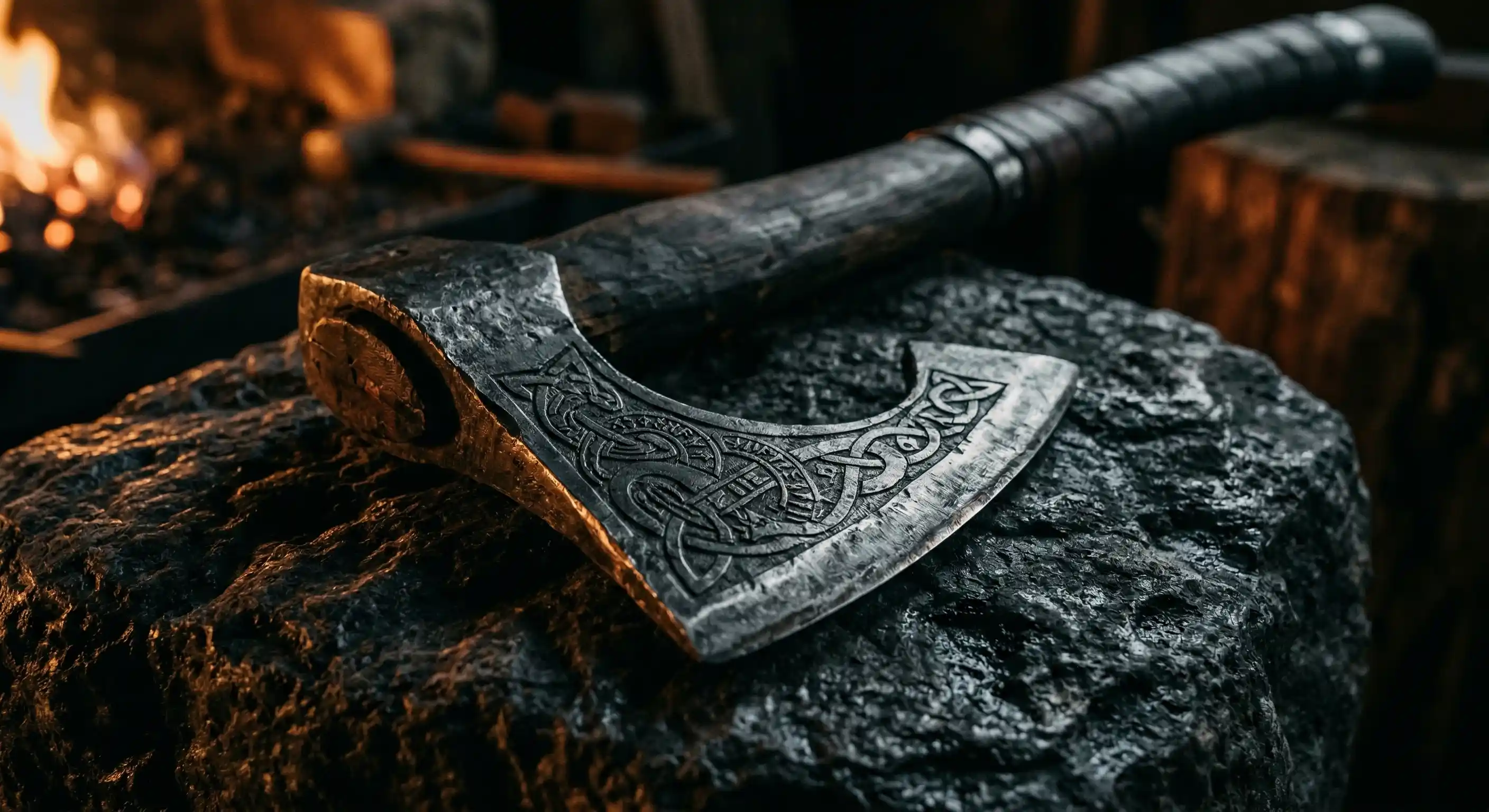
Of all the weapons that defined the Viking Age, none is more closely associated with Norse warrior culture than the bearded axe. Instantly recognizable by its distinctive hooked blade, the bearded axe was the go-to weapon of Viking warriors for over three centuries, valued for its versatility, its deadly effectiveness in combat, and its remarkable engineering. Today it remains one of the most iconic symbols of Norse craftsmanship and warrior identity.
But what exactly made the bearded axe so special? Why did Vikings prefer it over swords, spears, and other axes? And what is the story behind its unique design? Here is everything you need to know.
What is a Bearded Axe?
The bearded axe, known in Old Norse as the skeggøx, takes its name from its most distinctive feature: the “beard,” a downward extension of the lower blade that dramatically lengthens the cutting edge without adding significant weight to the axe head. This extension creates a hook-like protrusion below the handle socket that gives the weapon capabilities far beyond those of a conventional axe.
The result is an axe head with a cutting edge significantly longer than its height, combining the cutting power of a much larger weapon with the weight and balance of a compact, one-handed tool. It is one of the most elegant solutions in the history of weapon design, and it remained essentially unchanged for centuries because it worked so perfectly.
The Origins of the Bearded Axe
The bearded axe has roots that predate the Viking Age by several centuries. Early versions of the design appear in Scandinavian archaeological finds from the Migration Period, roughly 400 to 600 AD, suggesting that Norse craftsmen were experimenting with extended blade geometries long before the Viking Age began in earnest with the raid on Lindisfarne in 793 AD.
By the 8th century, the bearded axe had become the dominant axe design across Scandinavia. Its superiority over conventional axe designs in both combat and everyday use had made it the standard tool of Norse society, carried by farmers, craftsmen, hunters, and warriors alike. When the Vikings began their expansion across Europe, the bearded axe went with them, appearing in graves, hoards, and battlefield sites from Ireland to Russia.
The Engineering of the Beard
Why the Beard Changes Everything
The beard of the skeggøx is not merely a decorative feature. It is a precisely engineered solution to one of the fundamental challenges of axe design: how to maximize cutting edge length without increasing the weight of the axe head to the point where it becomes unwieldy.
A conventional axe head has a cutting edge roughly equal to the height of the axe head itself. By extending the lower blade downward into the beard, Viking blacksmiths created a cutting edge that could be fifty percent or more longer than the height of the axe head. This meant more cutting power per swing, a longer arc of contact with the target, and a more forgiving margin for slightly off-center strikes.
The Hook in Combat
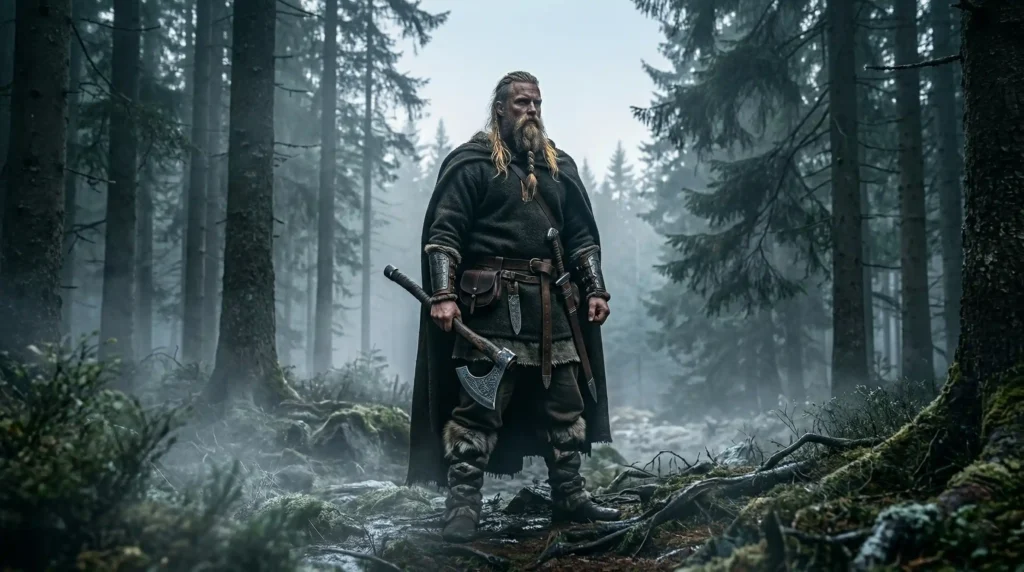
The hook created by the beard was not just a byproduct of the extended blade. It was a deliberate combat feature that gave the bearded axe capabilities no other weapon of its era could match. A skilled warrior could use the beard to hook an opponent’s shield and pull it sharply downward or sideways, exposing the warrior behind it for a follow-up strike. He could use it to trap an incoming sword blade, locking the opponent’s weapon and creating an opening for a counterattack. He could hook the beard around an opponent’s ankle or leg to bring him to the ground.
These techniques, documented in Norse sagas and confirmed by modern practitioners of historical European martial arts, made the bearded axe one of the most tactically sophisticated close-combat weapons of the medieval period.
The Grip Zone
One often overlooked feature of the bearded axe is the grip zone it creates on the shaft. Because the beard extends below the handle socket, a warrior could choke up on the handle and grip the shaft immediately below the axe head, using his thumb hooked over the beard for control. This shortened grip allowed for much finer control of the weapon in close quarters, enabling precise thrusting and parrying movements that would be impossible with a conventional axe.
This versatility, the ability to fight at long range with a full grip on the handle and at close range with a choked-up grip behind the beard, made the bearded axe uniquely adaptable to the chaotic, rapidly changing situations of real combat.
The Bearded Axe in Viking Society
A Tool for Every Purpose
Unlike the sword, which was purely a weapon, or the spear, which had limited utility outside of combat, the bearded axe was a genuine multipurpose tool. The same axe a Viking warrior carried into battle could be used to fell trees, split firewood, shape timber for shipbuilding, butcher animals, and perform dozens of other practical tasks. This dual utility made the bearded axe uniquely valuable in the self-sufficient world of Viking Age Scandinavia, where every piece of equipment needed to justify its weight and cost.
Norse sagas consistently portray the axe as an intimate personal possession, named and cared for like a trusted companion. The famous axe Flugumýrarøx, carried by the Icelandic warrior Skarpheðinn Njálsson in Njáls Saga, is described with the same reverence normally reserved for legendary swords. This personal relationship between a Viking and his axe reflects the centrality of the weapon to Norse identity.
Symbols and Engravings
Many surviving bearded axes from the Viking Age bear decorative engravings, inlays of silver or bronze, and Norse symbolic motifs. The famous Mammen axe, discovered in a 10th century Danish grave, is one of the most elaborately decorated Norse weapons ever found, its blade covered in intricate silver and gold inlay work depicting mythological scenes. This level of artistic investment confirms that the bearded axe was not merely a utilitarian tool but a deeply meaningful cultural object.
Common Viking symbols found on axe blades include the Vegvisir compass, the Valknut, the Helm of Awe, and runic inscriptions invoking the protection of Odin or Thor. These symbols transformed the axe from a weapon into a spiritual object, a direct connection between the warrior and the gods of the Norse pantheon.
Famous Bearded Axes in History and Archaeology
The archaeological record of the Viking Age is rich with examples of bearded axes. Hundreds of specimens have been recovered from graves, rivers, and battlefield sites across Northern Europe, ranging from simple working axes with minimal decoration to elaborately ornamented weapons clearly intended for a wealthy and powerful owner.
The Langeid axe, discovered in Norway in 2011 and dated to around 1000 AD, is one of the finest examples ever found. Its blade bears silver inlay decorations and runic inscriptions, and its size and quality suggest it belonged to a warrior of significant status. The Langeid axe is now considered one of the most important Viking Age weapon finds of the 21st century.
The Bearded Axe Today
The legacy of the Viking bearded axe extends far beyond the medieval period. Its influence can be seen in traditional woodworking axes used by craftsmen around the world, in the designs of modern bushcraft and outdoor axes, and in the growing community of historical European martial arts practitioners who study and practice Viking Age axe fighting techniques.
For collectors and history enthusiasts, a hand-forged bearded axe with authentic Norse engravings represents one of the most direct connections available to the warrior culture of the Viking Age. At Viking-Axe.com, every axe in our collection honors the tradition of the skeggøx, individually hand-forged from high-carbon steel using traditional Norse blacksmithing techniques. Browse our full collection of authentic hand-forged Viking axes and find the bearded axe that speaks to your Viking soul.