
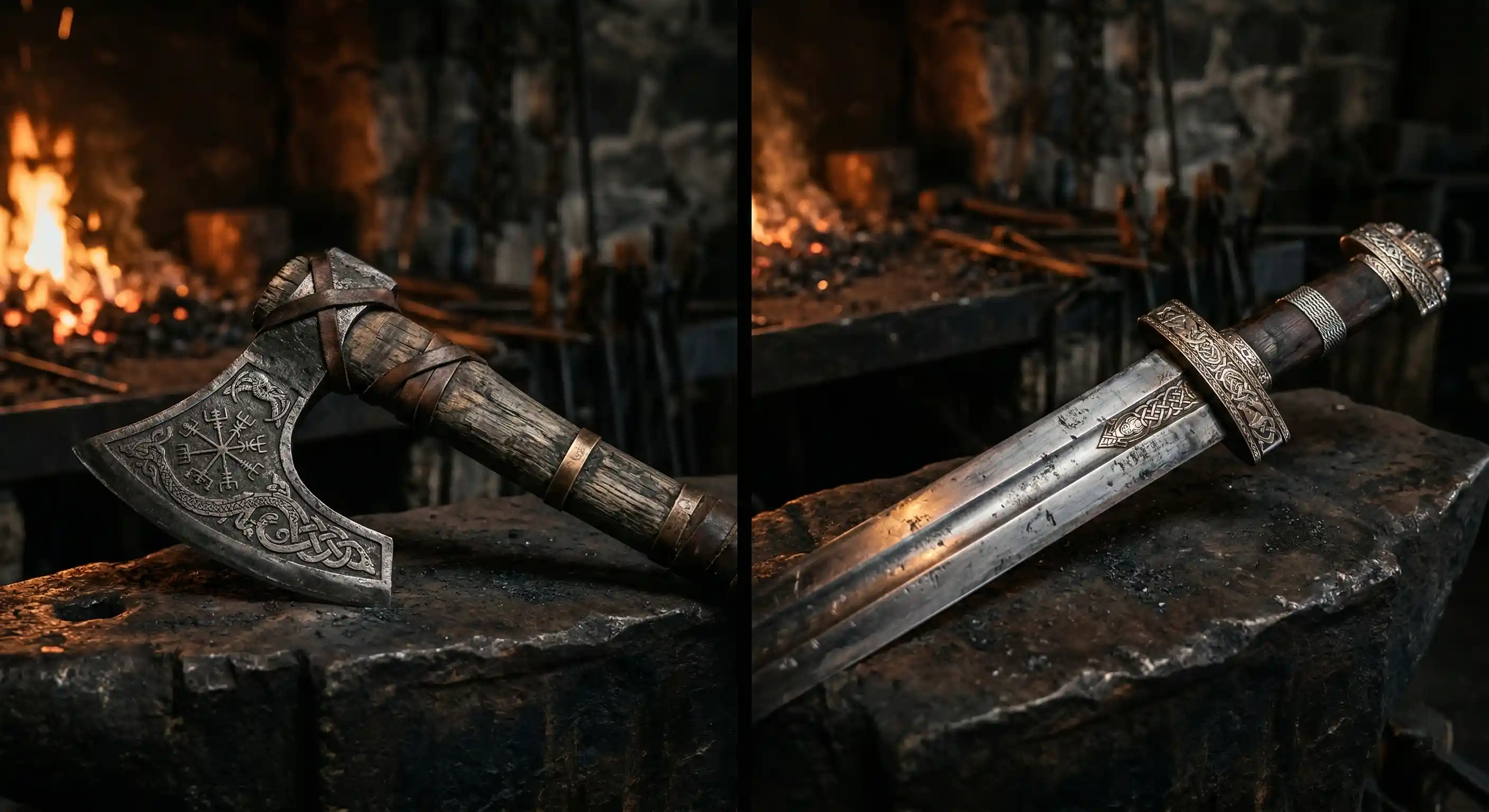
When most people picture a Viking warrior, they imagine a fearsome figure wielding a sword. Hollywood, video games, and popular culture have long romanticized the Norse sword as the ultimate symbol of Viking power. But the historical reality tells a very different story. For the vast majority of Viking warriors, the axe was not a backup weapon or a secondary choice. It was the weapon of choice, the tool they trained with from childhood, the instrument they carried into every raid, every battle, and every duel.
So why does the sword dominate our imagination? And what does history actually tell us about the weapons Vikings really preferred? Let us settle this debate once and for all.
The Viking Sword: Prestigious but Rare
The Symbol of the Elite
The Viking sword was undeniably impressive. A typical Norse sword featured a straight, double-edged blade between 70 and 90 centimeters long, a single-handed grip, and an elaborate hilt often decorated with silver, gold, or intricate knotwork patterns. In the hands of a skilled warrior, it was a fast, versatile, and deadly weapon.
But Viking swords were extraordinarily expensive to produce. Forging a high-quality sword required specialized skills, rare materials, and weeks of work from an experienced blacksmith. The result was a weapon that cost the equivalent of several cows, a price far beyond the reach of most Norse warriors. Swords were status symbols as much as weapons, passed down through generations as treasured heirlooms, given as gifts by kings to their most loyal followers, and buried with their owners as grave goods for the journey to Valhalla.
Who Actually Carried Swords?
Archaeological evidence confirms that swords were carried primarily by wealthy warriors, chieftains, and kings. A typical Viking raiding party of fifty men might include only five or ten sword bearers. The rest relied on axes, spears, and knives. In the hierarchical world of Viking society, your weapon told the world exactly who you were and where you stood.
The Viking Axe: The True Weapon of the Norse Warrior
Affordable, Practical and Deadly
The Viking axe was everything the sword was not. Where the sword required specialized forging techniques and rare high-carbon steel throughout the entire blade, an axe head could be produced quickly and cheaply from a much smaller amount of quality steel. The cutting edge required careful forging, but the body of the axe head could be made from lower-grade iron, dramatically reducing the cost and time of production.
This meant that virtually every Viking warrior, regardless of his wealth or social standing, could afford a high-quality axe. From the poorest farmer turned raider to the wealthiest jarl, the axe was the universal weapon of the Norse world. It was also a tool used daily for chopping wood, building structures, and butchering animals, meaning every Viking man grew up handling axes from an early age and developed an instinctive familiarity with the weapon long before he ever set foot on a battlefield.
Versatility in Combat
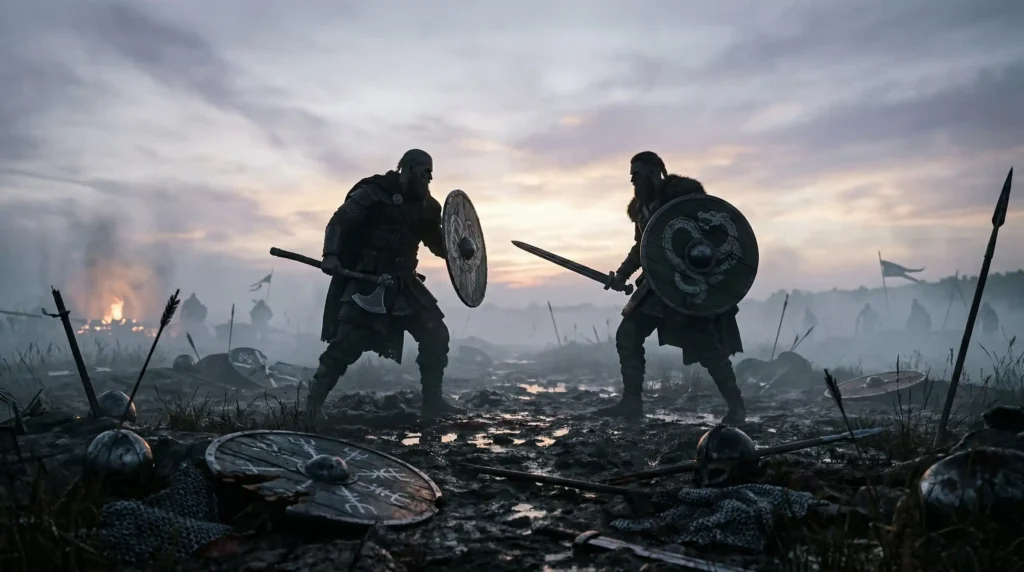
The Viking axe was a remarkably versatile combat weapon. Its bearded blade, with the distinctive downward-extended cutting edge, gave it capabilities that no sword could match. A skilled axe fighter could hook an opponent’s shield and pull it away, exposing the warrior behind it. He could use the beard of the axe to trap an opponent’s weapon. He could deliver devastating chopping blows from unexpected angles, attack over the top of a shield wall, or use the butt of the handle as a close-quarters striking weapon.
Single-handed axes gave warriors the option to fight with a shield in the other hand, combining offense and defense in the classic Norse fighting style. Larger two-handed axes like the famous Dane axe sacrificed the shield for raw reach and power, capable of cleaving through shields, armor, and opponents in a single blow.
The Bearded Axe: An Engineering Marvel
The bearded axe, known as the skeggøx in Old Norse, represents the pinnacle of Viking axe design. Its elongated lower blade created a cutting edge far longer than the width of the axe head itself, maximizing cutting power while keeping the overall weight of the weapon low. The hook created by the beard could be used offensively to grab and pull, or defensively to catch an incoming blade.
Modern weapons historians and martial arts practitioners who study historical European martial arts consistently rank the Viking bearded axe as one of the most sophisticated and effective close-combat weapons ever designed. Its geometry is so well thought out that it remains essentially unchanged in traditional axe designs used by craftsmen and woodworkers today.
What Archaeological Evidence Tells Us
The debate between axe and sword is not just a matter of historical opinion. The archaeological record speaks clearly. Excavations of Viking Age graves, battlefields, and settlements across Scandinavia, the British Isles, and beyond have consistently found axes in far greater numbers than swords. At sites like Repton in England, where a large Viking army wintered in 873 AD, axes dominate the weapon finds overwhelmingly.
Norse sagas, the epic literary accounts of Viking Age life written down in medieval Iceland, also confirm the primacy of the axe. Heroes and villains alike fight with axes in the sagas. Famous Norse warriors like Gunnar of Hlíðarendi and Skarpheðinn Njálsson were celebrated for their axe-fighting prowess. The axe appears in Norse mythology, law codes, and religious practice in ways that confirm its central role in Viking culture far beyond simple battlefield utility.
The Spear: The Forgotten Third Option
Any honest comparison of Viking weapons must also acknowledge the spear, which was actually the most numerically common weapon of the Viking Age. Cheap, simple, and effective at range, the spear was the standard weapon of the ordinary Norse foot soldier. But unlike the axe, the spear lacked the versatility and the cultural prestige that made the axe so central to Viking identity. It was a tool of war, not a symbol of the warrior spirit.
So Which Did Vikings Really Prefer?
The answer depends on who you are asking about. Viking kings and wealthy warriors preferred swords when they could afford them, using them as symbols of status as much as weapons of war. But for the vast majority of Norse warriors, farmers, traders, and raiders who made up the backbone of Viking society, the axe was the weapon of choice by necessity, by familiarity, and by preference.
The axe was cheaper, more versatile, easier to maintain, and deadlier in the hands of someone who had grown up using one every day of their life. It was the weapon that built Viking civilization, won Viking battles, and defined the Viking warrior in the eyes of their enemies across medieval Europe.
The sword was the weapon of kings. The axe was the weapon of Vikings.
Own a Piece of Viking Warrior History
The tradition of Norse axe craftsmanship lives on today. At Viking-Axe.com, every axe in our collection is individually hand-forged using traditional Norse blacksmithing techniques, crafted from high-carbon steel with authentic Norse engravings. Browse our full collection of authentic hand-forged Viking axes and find the piece that connects you to the true warrior tradition of the Norse world.